EHS Database
This smart phone version is currently under construction. Some functions may not work correctly. The PC version is not affected.
Welcome to the Elham Historical Society database website. Feel free to browse and uncover the history of Elham. Our dedicated team of historians has recently finished recording the details on all the memorials in the graveyard.
Our chairman Derek Boughton has overseen the operation, correlating the data and checking for errors. The results of their labours can be seen on the burials page.
Swing Riots
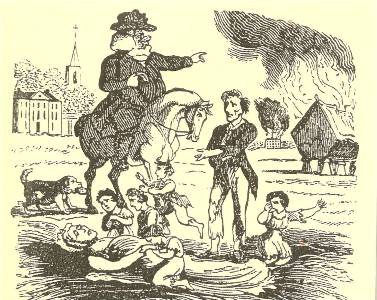
The machine breaking that led to the riots of August 1830 onwards started in the Elham Parish, writes our historian Derek Boughton, who has made a lifetime's study of the subject.
Elham residents were prominent in the gangs that sought out the new fangled threshing machines and destroyed them. Some of them cost the not inconsiderable sum for the day of £100.
Full Story
Les Ames (1905 - 1990)
Former Elham resident Leslie Ethelbert George Ames CBE; who died suddenly at his home in Canterbury on February 26 1990 - aged 84 - was without a doubt the greatest
wicketkeeper-batsman the game has so far produced; and yet - at the time he was playing - it used to be said there were better wicketkeepers than Ames - and that he was in the England
team because of his batting. If this was so would Jardine - for example - have preferred him to Duckworth in Australia in 1932-33?
Surely not. When fully fit - Ames was England's
first-choice wicketkeeper from 1931 to 1939 - when he virtually gave up the job. For Kent - he was an integral part of their Championship side from 1927 to the first match of 1951
- when a sharp recurrence of back trouble - which had dogged him for so long - brought his career to an end while he was actually at the crease. By this time he had amassed 37248
runs - average 43.51 - made 102 hundreds - including nine double-hundreds - and passed 1000 runs in a season seventeen times - going on to 3000 once and 2000 on five occasions.
He had had a direct interest in 1121 dismissals - of which more than 1000 were effected when he was keeping wicket. His total of 418 stumpings is easily a record.
In Test cricket
- Ames played 47 matches - scoring 2434 runs with a batting average of 40.56 - and taking 74 catches - and 23 stumpings. Record 8th wicket partnership in all tests of 246 with
GO Allen :Made 123 in the pre-lunch session of the 1923 test against South Africa (a record for runs in a session): Scored centuries against every first-class county apart from Kent.
Unusually for a wicket-keeper - he also bowled over 200 overs - taking 24 first-class wickets with a bowling average of 33.37.
Ames was a Wisden Cricketer of the Year in 1929.
He was a pupil at the Harvey Grammar School in Folkestone and he also played five times for Gillingham FC.
Audrey Hepburn (1929 - 1993)
She came to village with her mother Dutch Baroness Ella van Heemstra. She lived at Orchard Cottage (now the Five Bells) and attended the private schools in the village square.
1846
Murder Most Horrid
On Wednesday morning Sharrock Bragg, a bricklayer, rose at an early hour, and while his wife was in bed with an infant by her side, he struck her violent blows on the temple with a hammer. He then committed the like violence on a little girl five years of age, which lay in a side bed, and then destroyed his own life by cutting his throat immediately afterwards. The particulars attending the dreadful catastrophe may be gathered from the subjoined evidence, which was adduced at the Coroner’s inquest on the bodies. It was held at the King’s Arms Inn before Mr. T.T.Delassaux, one of the county coroners. William Jaggers, a schoolmaster, residing in the village, said that he had lodged at the house of the deceased about ten months. The family consisted of Sharrock Rudd Bragg, his wife Mary, and two children; the eldest name Ellen, aged about five years, and an infant aged about four months. The conduct of the deceased man towards his wife and children was most kind. He had not heard an angry word uttered by him towards either of them. About four weeks ago the deceased went into his room, and remarked that he expected he should be transported, on which the witness said, “I suppose you have committed some great crime that deserves transportation”. He replied that he did not know that he had. He t he observed that he had been a bad man to his wife, and witness asking him what he had done, he replied that he had not acted rightly to her, but did not say in what manner. The deceased appeared not in his proper senses. He frequently seamed low and melancholy. On Tuesday night, about half-past ten o’clock, witness went to bed. Deceased, his wife, and children had retired before that time. About half-past five on the following, he heard something heavy fall on the floor in the room of the deceased; shortly before which he believed he heard the wife of the deceased groaning. The groans continued, and at times grew loader. About six witness got up and dressed himself, and on looking out of the window saw a little girl knocking at the front door. He immediately went downstairs and opened the door, but the child was gone. He then discovered some blood lying on the floor of the front room, which is under the apartment occupied by the deceased, and on looking up he perceived more dripping through the ceiling. He instantly called up a female named Quested, and desired her to go and open the bedroom door of the deceased. Ann Quested, the wife of a blacksmith, was next examined. She deposed that at about half-past six o’clock on Wednesday morning, she was called by the last witness to go into the deceased’s room. She did so, and was horrified on seeing the deceased man lying on the floor covered with blood. She also noticed the bedclothes saturated with blood. Being much alarmed, she hastened down stairs for assistance. James Bragg, brother to the deceased, said, that on Tuesday evening, about seven o’clock, he met his brother and some conversation with him. He accompanied him to North Elham, for some cabbage plants which he had purchased. For the last month, deceased has laboured under a depression of spirits. Witness was at work with him about three weeks ago, he was then strange in his conversation, and different from what he had been in the habit of being. He asked him several questions with a view to ascertaining the cause, but his answers were far from being collected. By the Coroner: From what he had seem and heard, he believed that the deceased was jealous of his wife. He had heard the deceased say, “If I was to die, there is another man ready to marry my wife.” Sarah Bragg, the wife of the last witness, was then called. She was one of the first to enter the deceased’s bedroom on the alarm being given. She saw the deceased man lying on the floor. He was quite dead and the upper part of his body was covered with blood, On a chair near his corpse she found a razor covered with blood. The one produced is the same. She went to the bed and lifted the infant from it. The mother was perfectly insensible and was groaning heavily. The little girl was in a side bed. She was covered with blood. They were both breathing. George Gale corroborated her testimony. The hammer produced he found near the body of the deceased on the floor. Several witnesses were then examined, who spoke to the melancholy and desponding state of the deceased’s mind. Upon one occasion he said he was done for, and hoped it would be a warning to others. Mr. James Beatie, surgeon, of Elham, described the injuries in graphic detail. The Jury found that “the deceased, Sharrock Rudd Bragg, killed and slayed Mary his wife and Ellen his daughter, while in an unsound state of mind, and whilst in that insane state did destroy himself by cutting his throat with a certain razor. The shocking catastrophe has created much sensation in the neighbourhood of Elham. The wretched man was in his twenty-ninth year, and bore a very good character.